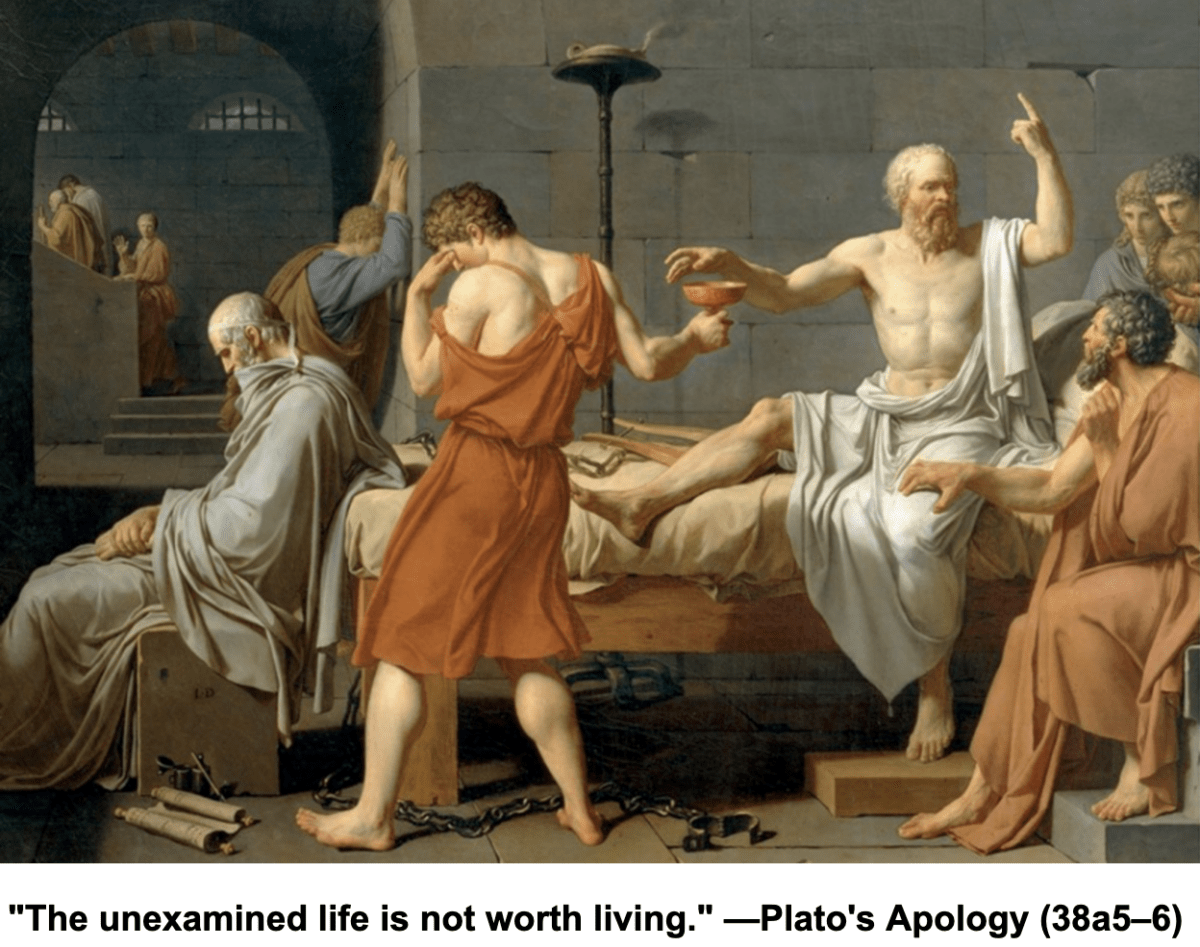
In the final chapter of Jane Eyre, our heroine is reunited, after a year’s separation, with the only man she ever loved, Mr. Rochester. The feeling is mutual. Indeed, Mr. Rochester’s joy at return is palpable: “You make me feel,” he says to Jane, “as I have not felt these twelve months. If Saul could have had you for his David, the evil spirit would have been exorcised without the aid of a harp.”[1]
This metaphor beautifully captures the man’s emotions in the moment. And I doubt that neither he nor Ms. Bronte, the author of this tale, would be troubled to learn that David never played the harp for Saul—or for anyone else, for that matter.
* * * * * * * *
How do we know this? To answer this question, we need only ask: When did David first come to the attention of His Majesty, Saul?
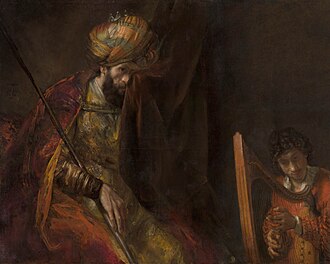
In 1 Samuel 16, David is introduced to Saul as a musician, a lyre player. But, in the next chapter, when he slays Goliath, it is clear that Saul is unacquainted with this courageous youth: “When Saul saw David going out against the Philistine, he said to Abner, the commander of the army, “Abner, whose son is this youth?” And Abner said, “As your soul lives, O king, I do not know.”[2]
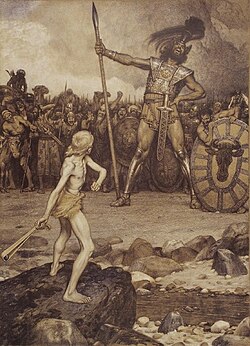
But wait, I’m not finished. There is compelling evidence that David never slew Goliath either. Indeed, in 2 Samuel 21:19 (NRSV), the death of Goliath is credited to an entirely different person: “Then there was another battle with the Philistines at Gob, and Elhanan son of Jaare-oregim the Bethlehemite killed Goliath the Gittite, the shaft of whose spear was like a weaver’s beam.”
One cannot persuasively argue that this is a different Goliath: both hail from the City of Gath and the spears of each are identical. Indeed, the description of their weapons in 2 Samuel 21:19 and 1 Samuel 17:7—“the shaft of his spear was like a weaver’s bar”—is word for word identical.[3] Further, as noted by the biblical scholar, Robert Alter, Elhanan’s account of the slaying of Goliath is arguably the more plausible.[4]
It is unlikely that anyone would take a story originally about David and attribute it to a nonentity such as Elhanan. But what is quite plausible is someone appropriating the heroic deeds of a relatively obscure individual in order to burnish the stature of a once and future king.
The author of the Book of Chronicles—a text written a century later than Samuel—spotted this inconsistency and sought to resolve it in a way which can only be described as comical: Elhanan didn’t really kill Goliath, the chronicler claims; rather, he slew Goliath’s brother, Lahmi. And, wouldn’t you know it, Lahmi’s spear was identical to that of his brother!

The story of David calming Saul’s troubled mind through the instrument of music was designed by the curators of David’s history to accomplish a similar purpose. David playing the harp is a vision of faith expressed in words, while his victory over Goliath is illustrative of faith expressed in action. Given this hagiographic depiction of David’s courage and character, how else could Michelangelo have portrayed David?

Having established David’s fitness for the monarchy, the author of 1 & 2 Samuel must now demonstrate (1) Saul’s unfitness for office, and (2) the willingness of Jonathan, Saul’s eldest son and heir apparent, to abdicate the throne in favor of David taking his place in the line of royal succession. This David does with relative ease, though his efforts strain credulity. For example, from his first appearance on stage, Jonathan is portrayed as gullible and more than willing to subordinate his interests to those of David. He is putty in David’s hands.
* * * * * * * *
The story of David, to paraphrase Walt Whitman, is of a man who “contains multitudes:” a boy, a man, a politician, a king, a survivor. And lastly a mere mortal, like the rest of us.
David seems almost as unfathomable as a Greek or Roman god. He begins as “the fair-haired boy of Israel.” Everybody loves him and willingly bends to his will. He excels in all of his endeavors—as a musician, warrior, and politician—and is brilliantly resourceful. But he is also calculating, and does nothing save that which advances his acquisition of power.
David is willing to do almost anything to survive, e.g., fleeing Saul’s assassins, making an alliance with the Philistines, slaying the inhabitants of entire towns in order to conceal his actions, profiting from the deaths in the House of Saul while conveniently distancing himself from each foul deed. In the words of the biblical scholar Robert Alter,
[David] is the first full-length portrait of a Machievellian prince in Western Literature. The Book of Samuel is one of those rare masterworks that … evinces an unblinking and abidingly instructive knowingness about man as a political animal in all his contradictions and venality and in all his susceptibility to the brutalization and the seductions of exercising power.”
And yet, he is human and compelled to reckon with his own mortality. Of this he becomes aware when his ailing infant son passes away. For the first time in his life he gives voice to a sentiment that has no clear political motive: “I am going to him. He will not come back to me.[5]
* * * * * * * *
When the Elders of Israel came to Samuel and asked for a king, man, as a political animal, was born. From that moment forward, Yahweh’s interests were represented by his prophets, “while the full and often contradictory set of human interests—personal, dynastic, and national—[were] represented in a king.”[6]
Nevertheless, prophecy was merged with monarchy, “lest divine law have no voice in the world. This double birth sets up the central conflict of the new regime … as a conflict between royal immorality and prophetic admonition.”[7] Thus, witness the Prophet Nathan unveiling David’s murder of Uriah, a dastardly deed performed to conceal David’s illicit affair with the dead man’s wife, Bathsheba. Nathan then proceeds to bear witness to David’s humiliation before the Lord.
Such sorrow is eternal.
[1] Charlotte Brontë, Jane Eyre, (London, England: The Folio Society, 1991), p. 407.
[2] John Barton, A History of the Bible: The Story of the World’s Most Influential Book, (New York, New York: Viking Press, 2019), p. 51.
[3] Baden The Historical David: The Real Life of an Invented Hero, (New York, New York: HarperCollins Publishers, 2013), p. 38.
[4] Robert Alter, The David Story: A Translation with Commentary of 1 and 2 Samuel, (New York, New York: W. W. Norton & Company, Inc., 1999) p. 334.
[5] 2 Samuel 12:22.
[6] Michael Walzer, In God’s Shadow: Politics in the Hebrew Bible, (New Haven, Connecticut: Yale University Press, 2012), p. 67.
[7] Ibid.
Thanks for your insights. David has always left me in a quandary.
Robert Alter’s, ‘Hebrew Bible: A Translation and Commentary, includes the traditional story of David and Goliath, and his notes and commentary make no mention of this being a fanciful invention. Is he simply giving deference to the JPS Translation?
Michael, Alter’s commentary for 1 Samuel 17: 25 in his book “Ancient Israel The Former Prophets: Joshua, Judges, Samuel and Kings” refers to the slaying of Goliath by David as an archetypal folktale: “a community is threatened by a giant, or ogre, or dragon nobody can face. The king offers great wealth, and hand of his daughter, to the man who can slay the giant. A young man from the provinces then appears on the scene, who in his youth and slight statute seems quite unfit for the daunting challenge, but by wit and resourcefulness, using unexpected means, he conquers the ogre. The appeal of the archetypal folktale no doubt made it attractive for inclusion in the David narrative.”
And his commentary for 2 Samuel 21:19, where an unknown man named “Elhanan” slays Goliath reads as follows: “In the literary shaping of David’s story, a triumph originally attributed, perhaps with good reason, to Elhanan was transferred to David and grafted onto the folktale pattern of the killing of a giant or an ogre by a resourceful young man. The writer used this material, as we have seen, to shape a vivid and arresting portrait of David’s debut.”
Alter’s folktale/carefully-calculated-political-invention hypothesis, is, based on my research, the consensus of most biblical scholars. Also, he makes no mention of the JPS translation, which, in my opinion isn’t surprising since his translation is source-oriented, emphasizing the poetic and, at times, abruptness of ancient Hebrew while the JPS translation prioritizes readability and modern English syntax.
The commentary in his book, “The David Story,” which I cite in my essay, is virtually identical, and includes a brilliant assessment and overview of David’s character, some of which I quote in my essay.
The man was the archetypical politician whose character has found expression in many of the political leaders of our country since its founding.
It did seem a bit over the top to have David regarded as a bard/fighter/strategist/leader/cleric/poet proficient with a harp. So many attributes and accolades and all I can think about is David’s reaction when he died and bumped into Uriah.