The Book of Numbers (arithmoi gk), so named because of the census in Chapter 1, contains a complex mix of materials—different “genres,” you might say—such as, laws, poetic folk traditions, ritual texts and narratives. The dominant storyline, however, is the comings and goings of the Israelites on the Siani Peninsula, along with Yahweh’s provision for his people. Who, I should add, frequently complain and periodically rebel.
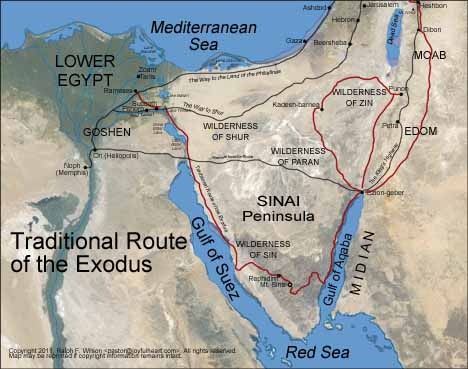
God never intended for his people to wander in the desert for forty years. Indeed, about eighteen months after they escaped the clutches of the Pharoah, he guided them to the land of Cannan and then instructed Moses to send a dozen spies (one from each of the twelve tribes) to scout out the area.
Forty days later they returned with fantastical news! It was a land that “surely floweth with milk and honey!” But, they cautioned, “the people be strong that dwell in the land, and the cities are walled, and very great …,”[1]implying that the people of Cannan are both powerful and unconquerable. Unsurprisingly, this frightened their audience.
Then, a man called Caleb, one of the twelve spies, hushed the crowd, and attempted to neutralize the pessimism of his colleagues: “Let us by all means go up, and we shall gain possession of [the land] for we shall surely overcome [them].”[2] Note that Caleb never mentions that God will be on the side of the Israelites. Rather, he genuinely believes they have the military capacity to prevail.
Though Joshua echoed the sentiments of Caleb, the other ten spies adamantly opposed the mission, causing the people to panic: “If only we had died in the land of Egypt,” they wailed. “If only we might die in the wilderness.” In their overwrought state of mind, they even suggested that “it would be better … to return to Egypt.”[3]
Let me ask you a question, dear reader: “Would you have behaved differently if you were in the shoes (er … sandals) of the Israelites?” Before answering, here are a few other questions: “Have you ever been a slave?” “If so, were you born into slavery?” “And were your parents, grandparents, great grandparents, and great, great grandparents also slaves?”
One last question: “Do you have any idea what it’s like to be a slave?” The Israelites did.
* * * * * * * *
Perhaps the most ominous verse in the Hebrew Bible is Exodus 1:8: “Now there arose up a new king over Egypt, which knew not Joseph.”
As a people, the Israelites (thanks to Joseph’s legacy) had been allowed under previous administrations to live in Egypt and work the land. But the new king felt threatened by their numbers and industriousness. He dealt with this perceived threat in a not-so-subtle way: infanticide, i.e., ordering the execution of all newborn Israelite males. Next, he sought to degrade the work environment and living conditions of the Israelites by making them his slaves.
Their new Egyptian overlords worked them ruthlessly and made their lives intolerable.[4] As a result, they languished in misery and suffering.[5] Ultimately, their masters succeeded in breaking their spirits.[6]
The Israelites were held in bondage by the Egyptians for at least six generations, perhaps much longer. While the intergenerational psychological scars from involuntary servitude are well documented,[7] they are not perpetual. Nevertheless, after the cowardice he witnessed on the border of the Land of Cannan, Yahweh had no choice but to prolong the Israelites’ wanderings for another 38 years. In other words, he felt compelled to write off an entire generation while he, with the help of Moses, nurtured their offspring with the courage, independence, and self-reliance they would need to build a nation.
* * * * * * * *
While we are fortunate to live in a country where involuntary servitude is expressly prohibited by law, it is voluntary servitude—i.e., outsourcing our agency to others, abdicating our hard-won freedoms—that concerns me the most. This was also an abiding concern of Boyd K. Packer, former President of the Quorum of the Twelve Apostles of the Mormon Church.
In a speech he delivered to the student body at Brigham Young University while I was studying there, he said: “There are too many in the Church who seem to be totally dependent, emotionally and spiritually, upon others. They subsist on some kind of emotional welfare.” He went on to chastise local church leaders who “dole out counsel and advice without the slightest thought that the member should solve the problem himself or turn to his family.”[8]
Fifteen years later Packer trained his sites on the man he sees in the mirror each day, along with his colleagues, acknowledging that the issue of “over-medication, over-programming is a critically serious problem. * * * * If we indulge [the members] too much, or make them too dependent, we weaken them morally, then they will be compelled by nature itself to find the wrong way.”[9]
For Elder Packer, “Spiritual self-reliance is the sustaining power of the church.”
* * * * * * * *
For decades, the Mormon Church discouraged tattoos and any body piercing, other than a single pair of ear piercings for women. But four years ago, it revoked that policy and replaced it with … well … nothing. It decided, instead, to leave the interpretation of “what is modest” to the individual and his or her parents. This was a long overdue change, in my opinion, but for some parents it was a source of consternation: “What do we tell our children now?!? What rules do we follow? We need guidelines!”
Now, most LDS parents were able to adapt to the new regime without much difficulty. Nevertheless, abiding by the admonition of our faith’s founder, Joseph Smith, to “Teach [the members] correct principles, and let them govern themselves” is a perpetual and universal problem. If you don’t believe me, just ask the Israelites. About 400 years after their arrival in the promised land, they voluntarily abandoned their system of Judges, which dispersed power among several wise men, in favor of a monarch. And did so to their everlasting regret.
[1] Numbers 13:27.
[2] Numbers 13:30.
[3] Rabbi Joseph Telushkin, Biblical Literacy: The Most Important People, Events and Ideas of the Hebrew Bible (New York, New York: HarperCollins, 1997), p. 132.
[4] Exod. 1:13,14.
[5] Exod. 3 7.
[6] Exodus 6:9.
[7] Benjamin P. Bowser & Aimé Charles-Nicolas, eds. The Psychological Legacy of Slavery: Essays on Trauma, Healing, and the Living Past, (Jefferson, North Carolina: McFarland Publishing, 2021).
[8] Elder Boyd K. Packer, “Self-Reliance,” (Ensign, August 1975), p. 85, https://www.churchofjesuschrist.org/study/ensign/1975/08/self-reliance?lang=eng last accessed on May 9, 2026.
[9] Elder Boyd K. Packer, “Let Them Govern Themselves,” (Regional Representative Seminar, March 30, 1990), https://oneclimbs.com/wp-content/uploads/let-them-govern-themselves.pdf, last accessed on May 9, 2026. Note Bene: To the best of my knowledge, you cannot find the full text of Packer’s remarks on LDS.Org.
Eric,
As always insightful and enlightening.
Your ability to provide such depth all while stating such in a succinct and well researched manner is manna to my mind.
Thanks again for yet another such gem.
This reminded me of Robert D Lupton’s warning regarding the shift of needs to rights, specifically the predictable progression going from appreciation to anticipation, anticipation to expectation, expectation to entitlement, and eventually entitlement to dependency. I prefer the way you write it, your essay is far more succinct and entertaining. You really have a gift for compelling storytelling!
Learning to navigate our new “freedom” from rigid dress and grooming standards has been an on-going discussion in our home. I, for one, went out and got my second piercing almost immediately (something I’ve always wanted to do) but I’m still not sure about some of the outfits my kids come up with. I mostly just keep my mouth shut and try to let them figure it out for themselves but I do sometimes miss the conciseness and ease of specific guidelines. Sometimes it’s nice to say “because the prophet said so” instead of “because I said so”. Ha!