The Come Follow Manual devotes no more than a couple sentences to the Book of Ruth, neither of which attempts to offer a meaningful interpretation of the written text. Which is a shame, since Ruth’s story greatly augments our understanding of the evolution of Israelite culture and theology while simultaneously providing a bridge between her day and Christ’s ministry, Paul’s mission, and our own time.
Let us start with the very first verse of Ruth: “In the days when the judges ruled, there was a famine in the land, and a certain man of Bethlehem in Judah went to live in the country of Moab, he and his wife and two sons.”[1]
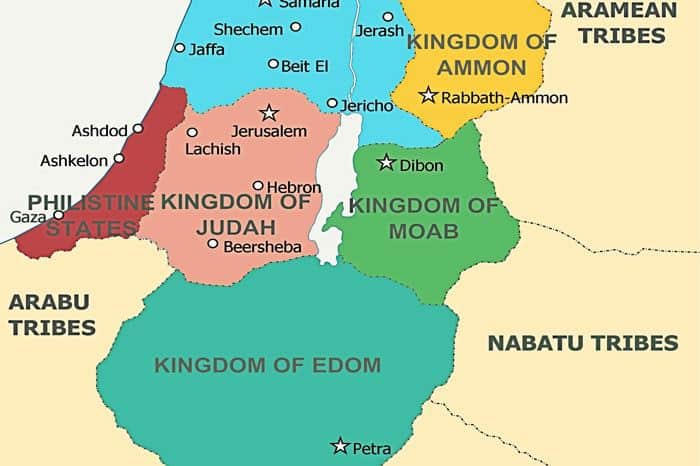
The word “Moab” suggests something quite controversial—rather incestuous, I dare say—is about unfold. You see, Moab was the name given to the son born to Lot’s first daughter after she had seduced her intoxicated father. Lot’s second daughter used the same ploy to persuade Lot to sleep with her the following night. Ben-ammi was the name of the son she bore; and was the first ancestor of Ammonites. As we have already learned, the Moabites and the Ammonites were arch enemies of the Israelites.[2]
These ethnic biases and hostilities notwithstanding, the fear of starvation drove this Bethlehemite family to seek refuge in the Kingdom of Moab. The father’s name was Elimelech and the mother was called Naomi. She gave her husband two sons: (i) Mahlon (sickly, heb.), (ii) and Chilion (frail, death, heb.).
Shortly after the family arrived in Moab, Elimelech kicked the bucket, leaving Naomi and her two sons to fend for themselves. The boys, for their part, promptly took Moabite wives. The name of the first was Orpah (disloyal, heb.) while the other was called Ruth (companion, heb.). But the boys, ostensibly cursed with their father’s gene pool, died ten years later. So, at the end of the day we have three widows above ground and three men below.
Naomi resolves to return to the Kingdom of Judah, but urges her Moabite daughters-in-law to stay in their homeland where their chances of finding new husbands would be better.
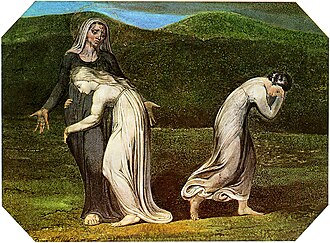
Orpah acquiesces to her mother’s request, but Ruth refuses, and does so in beautiful verse:
“Do not press me to leave you,
to turn back from following you!
Where you go, I will go;
where you lodge, I will lodge;
your people shall be my people
and your God my God.
Where you die, I will die,
and there will I be buried.
May the Lord do thus to me,
and more as well,
if even death parts me from you!”
Ruth’s decision, it should be noted, is born of loyalty to Naomi, and does not constitute a radical change in her theological convictions. Her act of faith, however, is enough of a foothold for Yahweh to reveal himself. Indeed, her decision to embrace a completely different religious culture is something one can only appreciate by experience. Some have even suggested that her faith surpasses that of Abraham since he was called by divine intervention and Ruth was not.[3]
* * * * * * *
The couple arrived in Bethlehem in the midst of the Barley harvest. Ruth, on her own initiative, went to the fields to glean the fallen sheaves behind the reapers in the field so the couple would have something with which to bake bread. Under Pentateuchal Law, a sheave dropped by a worker must be left for the poor to collect.
But Ruth has an ulterior motive.
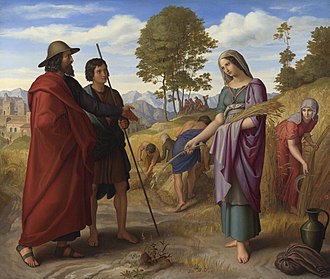
The field she has chosen is owned by a wealthy relative of Naomi, a man by the name of Boaz (strength, heb.). Her diligence captures his attention who takes her under his wing, offering safety from the rough field workers and supplying her with water to quench her thirst. Once Boaz learns of the sacrifices Ruth has made on Naomi’s behalf—leaving her friends and family in Moab and abandoning the faith of her fathers—he gives her a blessing, “May the Lord reward you for your deeds, and may you have a full reward from the Lord, the God of Israel, under whose wings you have come for refuge!”[4]
Naomi is thrilled when she learns of the mutual attraction between Boaz and Naomi. She tells her daughter-in-law that Boaz is not just any relative; rather, he is a “redeeming kinsman.” A redeemer (go’el) is a person who, as a close relative, has certain legal obligations to other family members. Those obligations often include marrying the childless relative of a deceased family member and producing offspring for their ancestors.
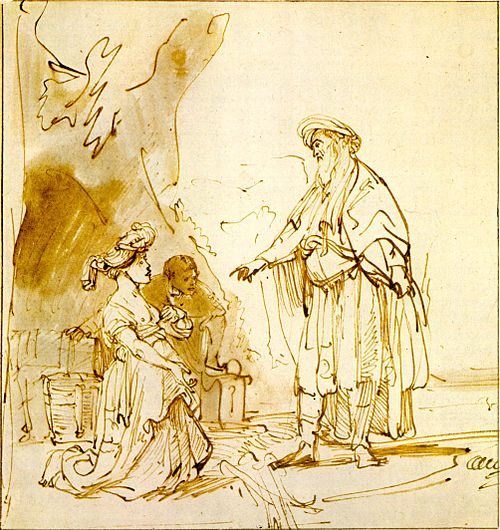
To make a long story short, Naomi and Ruth plot a not-so-chance encounter at night with Boaz as he winnows barley on the sheaving floor. Their plan of seduction works, and the couple are wed. Not long thereafter, Ruth gives birth to a healthy boy.
The Hebrew Bible, it should be noted, rarely condemns deceptions such as the one orchestrated by Naomi and Ruth. To the contrary, in the biblical world, cunning and guile are admirable traits in the powerless, ones often essential to their survival.[5]
It is impossible to overstate how gobsmacked a Judean audience would have been upon hearing this story. In the words of one biblical scholar, “it stands in pointed opposition to: (i) the negative view of foreigners, (ii) the ban on intermarriage, and (iii) the purely genealogical definition of Israelite identity promulgated by Ezra and Nehemiah in the postexilic period.”[6] Postexilic and rabbinic Judaism never adopted Ezra’s “holy seed ideology.” Instead, the faith continued to allow assimilation and, later, conversion and marriage into the covenant community of persons who accepted the God of Israel. Naturally, the Book of Ruth is featured prominently in the Jewish conversion ceremonies of today.[7]
Boaz and Ruth named their son Obed, who was the father of Jesse, who, in turn was the father of David.[8] While this concludes the Book of Ruth, it is only the beginning of her story and influence on future generations.
* * * * * * *
The first chapter of the Book of Matthew, which recounts the lineage of Christ Jesus, acknowledges Ruth’s role as the mother of one of the Savior’s ancestors. Matthew also presages the role women would play in Christ’s ministry by featuring three other female ancestors: Tamar, Rahab, and Bathsheba (the wife of Uriah). Of the four, it is worth noting, two were Canaanites, while the third (Ruth), as we know, was a Moabite.
It is hard to exaggerate the role women played in the Savior’s ministry. They were disciples, patrons, witnesses and evangelists, proclaiming his gospel to all who would listen. They also provided financial support out of their own means.[9] Women were also some of his most devoted pupils, e.g., Mary of Bethany sitting at the feet the Savior while her sister was performing household duties.
Women also received and proclaimed important revelations, such as Mary’s announcement of Jesus’ birth from the angel Gabriel and Elizabeth recognizing the significance of Mary’s child before Christ’s birth.
We often overlook the complex logistics associated with housing, clothing and feeding the Savior and his disciples as they traveled. These services were provided almost exclusively by women.
Most significantly and courageously, while many of Christ’s male disciples fled after his arrest, several women (e.g., Mary Magdalene, Salome, and Mary) were direct witnesses of his death and burial and were the first witnesses of his resurrection.
Also, Ruth’s voluntary faith in the God of Israel and her subsequent grafting into the royal messianic line serves as a lodestar. New Testament writers, such as Paul, relied on this precedent to explain how Gentiles are spiritually grafted into God’s covenant family.[10]
Though this will come as a surprise to some, the Apostle Paul continued this tradition of treating women as equals. For example, in his letter to the Galatians, he declares: “There is no longer Jew or Greek, there is no longer slave or free, there is no longer male and female; for all of you are one in Christ Jesus.”[11]
In Romans, Paul mentions a woman named Phoebe who is both a deacon/minister in the church of Chenchreae and Paul’s own patron whom he entrusts with the task of carrying his letter to Rome. And there is Prisca, who along with her husband, Acquila, are responsible for missionary work among the Gentiles. The careful reader will note here, as is elsewhere, the wife’s name appears before the husbands.[12]
And then there is Mary, a colleague of Paul’s who works among the Romans. There are also Tryphaena, Tryphosa, and Persis, women who Paul calls his “co-workers” in the gospel. Most impressive of all, though, is Junia, a woman whom Paul calls (along with her husband) “prominent among the apostles.”[13] Lastly, there are only four times in Romans where Paul uses the Greek root for special apostolic activity—kopiao, which means “worked hard”—and in each instance he is describing a woman: Mary, Tryphaena, Tryphosa, and Persis.[14]
* * * * * * * *
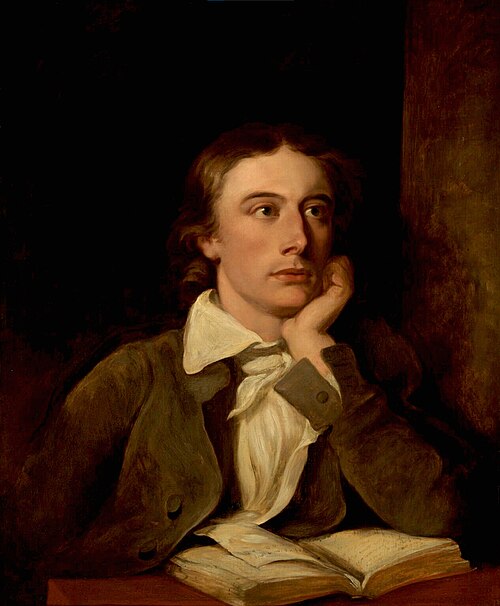
John Keats was twenty-one years old when his first volume of poetry was published in 1816. The book was a critical failure and his publishers were ashamed. But his new publishers were optimistic about his future and gave him a generous advance. Nevertheless, his next work, Endymion, published in 1818, was an epic disaster. To compound matters, Keats’ financial circumstances were precarious, as was his health. But he refused to quit.
A most serendipitous event occurred when Keats was introduced to Samuel Tayor Coleridge, the consensus founder of the Romantic Movement and a first-class poet, philosopher, and theologian in his own right. Their encounter lasted but forty-five minutes, with Coleridge talking non-stop on a vast array of subjects. But one thing, above all others, stuck in his mind: Coleridge’s complaint about the nightingales, their being “incessant with song.”
This was a song, however, associated with sorrow. In classical mythology, Philomela had been raped by Tereus, King of Thrace, who then proceeded to cut her tongue in order to prevent her from exposing his crime. Ultimately, a metamorphosis occurred, and she became a nightingale whose song is her futile attempt at speaking her rapist’s name.
Keats seizes upon the bird’s sad story as inspiration for his poem, “Ode to a Nightingale.” At one point he seems, in the words of Andrew Klavan, “to vanish into the nightingale’s trill as it comes to him through both history and fantasy:”[15]
Thou was not born for death, immortal Bird! …
The voice I hear this passing night was heard
In ancient days by emperor and clown:
Perhaps the self-same song that found a path
Through the sad heart of Ruth, when sick for home,
She stood in tears amid the alien corn;
The same that oft-times hath
Charm’d magic casements, opening on the foam
Of perilous seas, in faery lands forlorn.
As he struggles with his own grief and depression, he uses poetry (as did Ruth when she pledged fealty to Naomi) in search of way forward grounded only in faith. But in Keats’ imagination, there were moments when Ruth had doubts—which she most surely did—about her choice. When she longed for her homeland and the company of her sister-in-law, friends and family—memories be revived by the nightingale song’s ability to open magical windows in the mind where she could escape her sadness, if only for a moment.
Surely Keats was on to something here. Which should only augment our appreciation and gratitude for the sacrifice Ruth made—not just for Naomi, but for the rest of us.
[1] Ruth 1:1 (NRSV).
[2] The story of Sodom and Gomorrah is an etiology. That is, it explains the enmity between Israel and its two neighbors by inventing a cause for it, to wit, an incestuous liaison and its inevitable byproduct: hostile and unclean offspring with whom interaction and intermarriage was forbidden. Simply stated, the story of Lot and his daughters is nothing more than trash talk, a nasty swipe by the Israelites at the Moabites and Ammonites.=
[3] NRSV Cultural Backgrounds, p. 457.
[4] Ruth 2:12 (NRSV).
[5] Tikva Frymer-Kensky, Reading the Women of the Bible: A New Interpretation of Their Stories, (New York New York: Schocken Books, 2002), p. 19.
[6] Christine Hayes, Introduction to the Bible, (New Haven, Connecticut: Yale University Press, 2012), p. 374.
[7] Ibid, pp. 377-378.
[8] Ruth 4:13-17.
[9] Luke 8:3.
[10] Romans 11:17.
[11] Galatians, 3:28 (nrsv), emphasis added.
[12] John Dominic Crossan & Jonathan L. Reed, In Search of Paul, (New York, New York: HarperSanFrancisco, 2004), pp. 114-115.
[13] Romans 16:7 (NRSV), emphasis added.
[14] A more problematic passage is found in Paul’s first letter to Timothy: “Let a woman learn in silence with full submission. I permit no woman to teach or to have authority over a man; she is to keep silent.” (1 Tim. 2:11-12 NRSV.) How can we possibly reconcile this statement with the liberal pronouncements regarding women elsewhere in Paul’s writings? We can’t. And we don’t have to. Because Paul didn’t write First Timothy.
Virtually all biblical scholars believe that First and Second Timothy, along with First and Second Titus, were written were written by second century followers of Paul who simply appropriated the great apostle’s name to legitimize their writings. This practice, known as “pseudoepigraph,” i.e., a falsely attributed work, whose text claimed author is not the true author, was quite common in the early church. They are easily detected for several reasons, to wit:
1. The writings of Timothy and Titus evince a fairly well-developed Church structure, one that did not exist in Paul’s day.
2. Theologically, many of the themes and approaches in these works run directly counter to the other letters of Paul known with a high degree of certainty to have been authored by him. Timothy and Titus also assume a good degree of doctrinal development and orthodoxy, both of which take time to evolve.
3. The style and vocabulary of Timothy and Titus are quite different from Paul’s other letters. The same words are used, but often in very different ways. And in some cases, the vocabulary seems to match a second century Greek lexicon, not a first century one, as it should.
[15] Andrew Klavan, The Truth and Beauty, (Grand Rapids, Michigan: Zondervan Books, 2022), p. 151.
Thank you for sharing all these insights about Ruth. It has always been one of my favorite stories and now I love it even more!
It always made me come up short to read the meaning behind the names in Naomi’s family (Who would name their kid “disloyal”, “sickly”, “frail”, etc?!); then I remember the point you’ve made in past essays and now see them as the author’s narrative literary device to foreshadow impending doom and sorrow for this family.
Still one of my favorite tales of cunning women in the Bible.