Before we take up Deuteronomy, there is a story in Numbers which warrants close scrutiny: “The Tale of the Fiery Serpents.”
What’s Up With These Snakes?
The Israelites, as was their wont, grew impatient during their search for The Promised Land and began to complain.
“Why did you [Moses] bring us up from Egypt to die in the wilderness? For there is no bread and there is no water, and we loathe the wretched bread [i.e., the manna from Heaven]. And the Lord sent against the people the viper-servants [fiery-serpents], and they bit the people, and many people of Israel died. And the people came to Moses and said, ‘We have offended, for we have spoken against the Lord and against you. Pray to the Lord that the He take the serpents away from us.”[1]
Now, we all know how sensitive chefs can be about their culinary creations, but the Lord’s response does seem a bit over the top, don’t you think? Not to worry. The Lord did not send an army of snakes to punish the Israelites because they were whiners or for any other reason. Yes, He created those serpents, along with many other poisonous snakes which, as noted by the biblical scholar Robert Alter, the Israelites had undoubtedly encountered during their sojourn in the desert.[2]
“But, Eric,” you protest, “the scripture says ‘the Lord sent against the people the fiery serpents …’”! So what? Ask yourself, “Who wrote those words?” A.-The Israelites. Next question: “Is the Lord quoted as speaking those words?” A.-No.
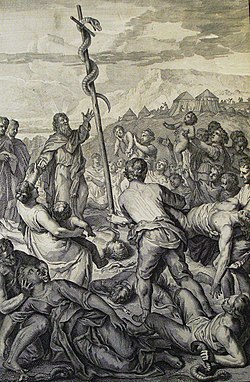
Also, compare the next verse: “And Moses interceded for the people. And the Lord said to Moses, ‘Make you a viper and put it on a standard, and so then, whoever is bitten will see it and live.’”[3] Here, the Lord is speaking, whereas in the previous verse, the people simply invented a reason for the sudden appearance of the fiery serpents. “But why,” you ask, would they do that?!?” Because—and here is the payoff—this was how they made sense of their world.
When there was a famine or an earthquake, or they were defeated by an enemy in battle, the Israelites, like all other ancient people, attributed their misfortune to their failure to please the God they worshiped. Climatology, meteorology, geology, physics and military science—along with the concepts of randomness and probability—were totally foreign to the ancients.
Do you want to understand why polytheism was such a huge problem for Jehovah? Look no further than the Book of Judges where the Israelites abandoned Yahweh to worship local Canaanite deities like Baal (the god of rain and fertility) after they were defeated in battle.[4] Or consider this passage from 2 Chronicles: “In the time of his distress King Ahaz became increasingly unfaithful to the Lord … He sacrificed to the gods of Damascus which had defeated him, saying, ‘Because the gods of the kings of Aram help them, I will sacrifice to them that they may help me.’ But they were the ruin of him and all of Israel.”
During his earthly ministry, Christ disabused his followers of these erroneous beliefs: “[your Father which is in heaven] maketh his sun to rise on the evil and the good, sendeth rain on the just and on the unjust.”[5] In other words, poop happens.
Lest we think we are somehow superior to those superstitious Israelites, consider this: well into the 18th century, Puritans believed that vaccines thwarted the will of God, that the disease you were trying to eradicate was punishment for some sin you had committed.[6] And then there’s this: between 25%-30% of Americans regularly consult astrology, tarot cards or fortune tellers.[7]
Finally, how often have you heard someone try to explain some tragedy or injustice with inanities such as: “Well, everything happens for reason.” Well, yes, that’s true. But in most instances, the reason is quite simple: somebody did something stupid.
Moses: On the Outside Looking in
Deuteronomy is a collection of several long speeches delivered by Moses on the banks of the Jordan River to the Israelites just before they commenced their conquest of the Promised Land. And the overriding theme of his remarks was REFORM! In other words, he was urging the Israelites to remember and recommit to the covenant they made with Yahweh at the beginning of their journey. Similarly, he reminded them of the covenant the Lord made with the foundational figure in Israel’s history: Abraham.[8] His pleas were accompanied by stern warnings of the consequences attendant to failure to heed his counsel.
This was also a farewell speech of sorts since Moses had been instructed by the Lord to confer the mantel of leadership on his divinely appointed successor—Joshua—and had been told he would not be allowed to set foot in the Promised Land. Aaron, likewise, was not allowed to cross the River Jordan and was soon to be released from all ecclesiastical duties.[9] But why? Had they done something to offend God? Well, yes.
* * * * * * * *
Moses and Aaron had recently committed an unpardonable gaffe in the eyes of God. The setting is yet another water shortage which the Israelites are quick to blame on the two brothers and to question, for the umpteenth time, their decision to leave Egypt. They say nothing in response to these spurious allegations, but instead retire to the Tent of Meeting whereupon they fall on their faces.[10]
Moses is depressed and weary, as is Aaron. In addition to putting up with this crap for almost 40 years, Moses and Aaron were mourning the loss of their sister, Miriam, whom they had just buried.
But before he says anything, the Lord commands Aaron to take the rod kept in the Holy of Holies, assemble the community, command a large rock to yield water. The water, God avers, will come gushing out instantly from the rock.[11]
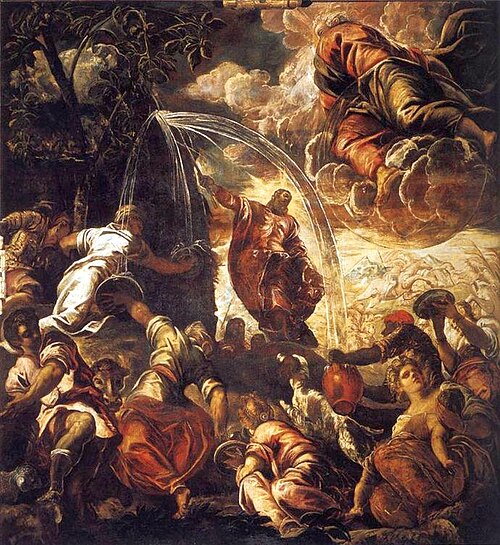
Moses and Aaron do as they were told. Once the community had gathered around the rock, Moses, in rather uncharitable language, said, “Listen, you rebels, shall we get water for you out of this rock?” Whereupon Moses strikes the rock with the rod and water comes gushing out.[12] Everyone was content. Except the Lord. He was pissed.
“Because you did not trust Me enough to affirm my sanctity in the sight of the Israelite people,” he says to Moses and Aaron, “therefore you shall not lead this congregation into the land I have given them.”[13]
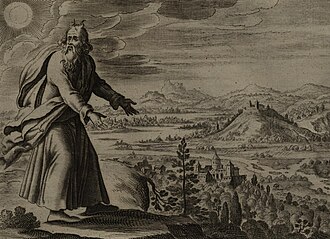
For thousands of years students and scholars alike have struggled to understand what triggered God’s wrath. Some concluded that Moses erred when he struck the rock with the rod instead of simply speaking to it, but that theory simply doesn’t hold water. What difference would this make? Besides, it would be cruel and unjust for the Lord to impose such a sever punishment for failure to follow protocol.[14]
The best answer, in my opinion, is the one proffered by the biblical scholar Jacob Milgrom who trains our focus on the rhetorical question posed by Moses, in Aaron’s company, to the rebellious Israelites: “Shall we get water for you out of this rock?” His use of the third person plural “we” excluded God. In other words, Moses and Aaron were taking credit for this miracle, an unforgivable act of idolatry. And they can’t say they weren’t warned. Indeed, Moses, in one of his final speeches, reminded the people: “For the Lord your God is a consuming fire, a jealous God.”[15]
* * * * * * * *
The Problem of Charisma
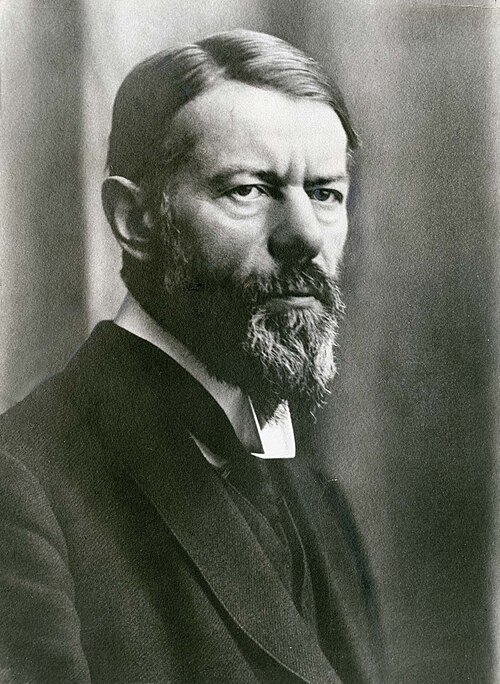
Maximilian Carl Emil Weber (1864-1929) was a brilliant German sociologist, historian, jurist and political economist. Among other things, he enhanced our understanding of how leaders legitimize their authority, i.e., persuade people to follow them and do their bidding.
Weber identifies several different approaches—socialism, hereditary monarchies, democracy, etc.—which have worked well for the chief executives of nations, corporations, universities and churches. But the most intriguing of all is a leader whose power hinges on his charismatic authority.
Charisma, for Weber, is “a certain quality … by virtue of which [the leader] is set apart from ordinary men and treated as endowed with supernatural, superhuman or at least specifically exceptional powers or qualities.” Weber continues: “These are such as are not accessible to the ordinary person but are regarded as of divine origin…, and on the basis of them the individual concerned is treated as a leader.”[16]
A serious problem arises, however, when the leader dies or otherwise becomes incapacitated. His successor—unless he is similarly gifted (highly unlikely)—is faced with a seemingly insurmountable challenge of living up to the expectations created by his predecessor. To succeed, Weber, argues, the successor must find a way to mold the charismatic legacy bequeathed him by his predecessor into something more structured, more predictable and built on a foundation of established rules and authority. This, according to Weber, is the “routinization of charisma.” And Joshua did just that.
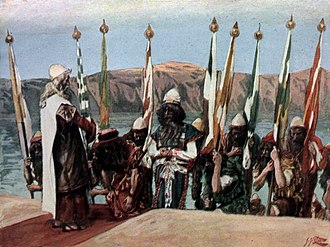
He started by reminding the Israelites of his divine affirmation. God, not Moses, chose him to be their new leader. And instead of change and innovation, Joshua validated his leadership by strictly adhering to the Torah, showing reverence for his predecessor’s teachings. And before he passed away, he gathered the Elders at Shechem for a “covenant renewal,” challenging them to make a personal commitment to serve. (It also didn’t hurt that he was quite successful in battle.)
* * * * * * * *
Can you, perchance, think of a modern religious figure—by “modern” I mean the past 200 years—who fits Weber’s model of a charismatic leader? How about Joseph Smith? If he came to mind, well, you’re late to the party. You see, for Weber, Joseph was the quintessential charismatic leader. And Smith’s murder at the hands of a mob in Carthage, Illinois presented similar challenges to his would-be successor.
There was no established succession plan in the event of Smith’s death. Unsurprisingly, there were several members of the Mormon aristocracy who jockeyed to take his place. At the end of the day, however, the choice presented to the Saints came down to two of Smith’s closest associates: Sydney Rigdon and Brigham Young.
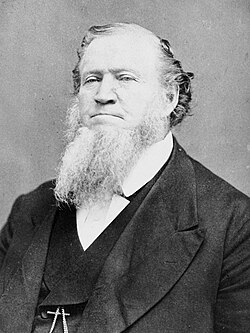
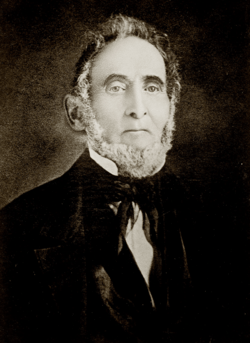
Six weeks after Smith’s death, the Saints gathered in the East Grove of Nauvoo, Illinois for a “rhetorical showdown” between the two contenders.[17] Rigdon spoke first, eulogizing the Prophet and claiming that: “this Church must be built up to Joseph, and that all the blessings we receive must come through him. * * * * Joseph sustains the same relationship to this Church as he has always done: no man can be the successor of Joseph …. The martyred prophet is still the head of this Church.”[18]
This was—to be charitable—a peculiar argument. In the words of Richard Bushman, “Rigdon was in effect denying Joseph’s death” and was “calling on Joseph’s charisma” to validate his claim to succession.[19] In essence, he wanted to replace “The Church of Jesus Christ of Latter-day Saints” with “The Church of Joseph Smith.”
Young saw an opening. Instead of “calling on Joseph’s charisma” to validate his claim to lead the church, he made succession a priesthood issue. His focus was no longer on Joseph but on Joseph’s system of priesthood keys and councils. “Once he realized that the priesthood keys had remained with the church and that the Quorum of Twelve Apostles possessed them, the right course was obvious.”[20] The Twelve, as a body, should lead the church and the question of Smith’s successor should be tabled.
Young carried the day and Rigdon was soundly defeated.
* * * * * * * *
Joseph had been dilatory on several matters of church government and administration. Young, by contrast, was diligent in these endeavors. “Where Joseph claimed charismatic inspiration,” resulting in well over 100 doctrinal revelations, Young’s contribution to church doctrine was modest. “I never pretended to be Joseph Smith,” Young declared. “I’m not the man who brought forth the Book of Mormon.”[21] But he did find a way to organize and build the kingdom on earth Joseph saw in the heavens.
Max Weber would have been impressed.
[1] Numbers 21:5-7 as translated by Robert Alter, The Five Books of Moses: A New Translation and Commentary, (New York, New York: W. W. Norton & Company, 2004), pp. 789-790.
[2] Ibid.
[3] Ibid, v. 8.
[4] Judges 2:11-15; 3:7.
[5] Matt. 5:45 KJV.
[6] Peter Manseau, One Nation Under Gods, (New York, New York, Little Brown and Company, 2015), pp. 119-140.
[7] Chip Rotolo, “30% of Americans Consult Astrology, Tarot Cards or Fortune Tellers,” Pew Research Center, May 21, 2025, https://www.pewresearch.org/religion/2025/05/21/3-in-10-americans-consult-astrology-tarot-cards-or-fortune-tellers/, last accessed on May 16, 2026.
[8] Lawrence E. Boadt, Reading the Old Testament: An Introduction, (Mahwah, New Jersey: Paulist Press, Inc., 2012), pp. 303-304.
[9] Deuteronomy 34:4, 9.
[10] Numbers 20:2-6.
[11] Numbers 20:7-8.
[12] Numbers 20:9-11.
[13] Numbers 20:12.
[14] Rabbi Joseph Telushkin, Biblical Literacy: The Most Important People, events, and Ideas of the Hebrew Bible, (New York, New York: William Morrow, 1997), p. 138.
[15] Deuteronomy 4:24.
[16] Max Weber, The Theory of Social and Economic Organization, (New York, New York: The Free Press, 1964), pp. 358-359.
[17] Alex Beam, American Crucifixion: The Murder of Joseph Smith and the Fate of the Mormon Church, (New York, New York: Public Affairs, 2014) p. 239.
[18] Richard Lyman Bushman, Rough Stone Rolling: A Cultural Biography of Mormonism’s Founder, (New York, New York: Alfred A. Knopf, 2005), p. 556.
[19] Ibid, p. 557.
[20] Ibid.
[21] American Crucifixion, p, 239.
I greatly appreciate your insight and will purloin the phrase “…this was how they made sense of their world” when explaining Greek, Roman, Egyptian, Norse, Hindu, Mesoamerican, etc. mythology to students.
Interesting and logical explanations for some OT stories which are otherwise challenging to understand. Thank you.
I love your ability to analyze interpret and explain powerful events meant to teach and enrich thee understanding of us mere mortals
Good essay. The insight that the ancients’ view of causation was very different from ours is an important one.
I’d love to see you do an essay on how (or whether) Yahweh in the Old Testament differs from the pagan gods, other than the obvious difference that Judaism was monotheistic while most other ancient religions were polytheistic.
While in this particular incident, Yahweh might not have sent the serpents to torment the Israelites, there are certainly plenty of other instances in the Old Testament where Yahweh acts with what, by New Testament standards, seems like capricious cruelty — the Flood that only Noah survived, to give perhaps the most obvious example.